
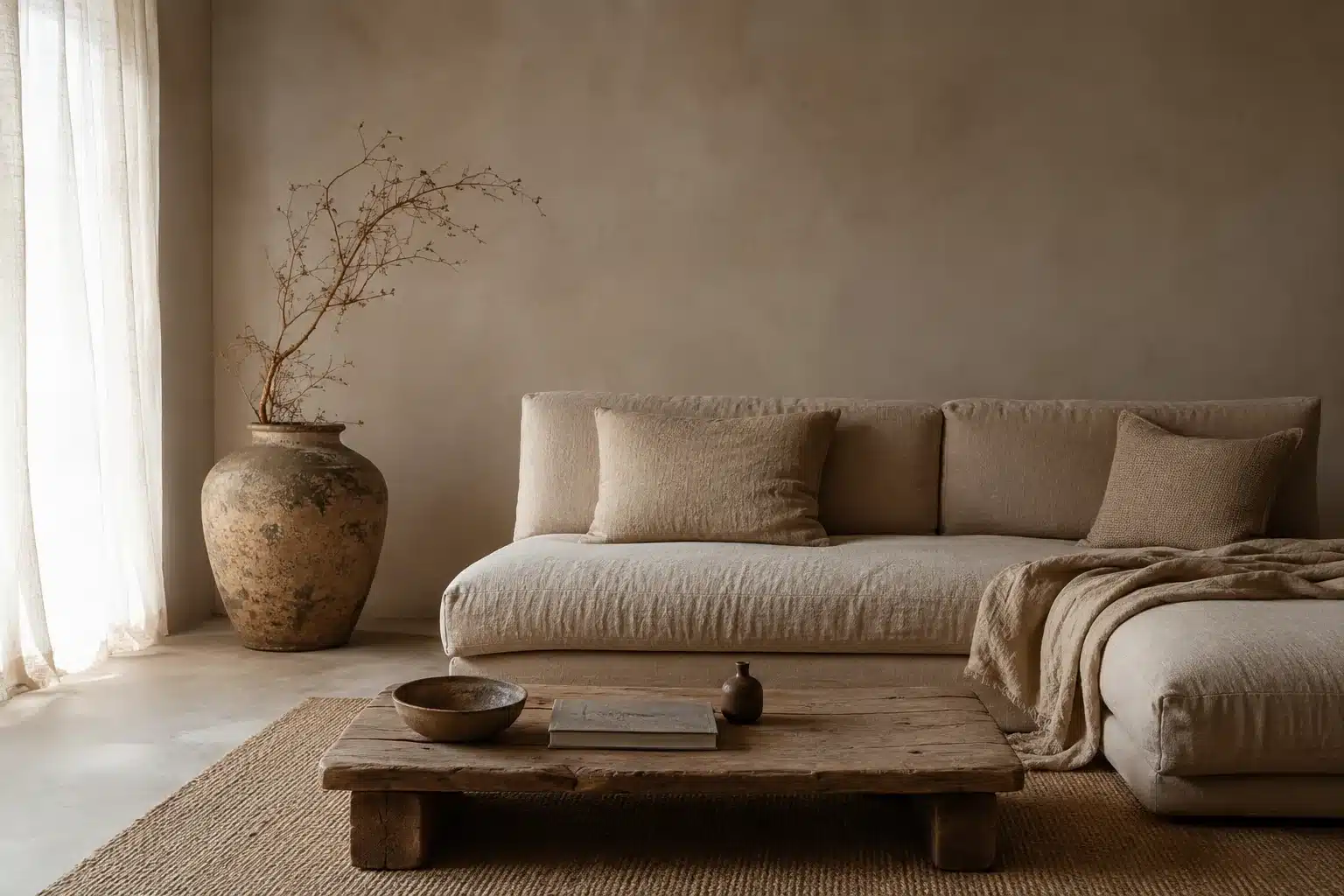
Wabi-sabi is a Japanese design philosophy built around finding beauty in imperfection, simplicity, and natural aging. If you’re searching for wabi-sabi living room design ideas, the goal isn’t a “perfect” showroom look — it’s a room that feels calm, textured, and honestly lived-in.
Here’s how to bring that feeling into your own living room.
1. Choose Imperfect, Natural Materials
Wabi-sabi favors materials that show their age gracefully: raw linen, unglazed ceramic, weathered wood, and hand-thrown pottery. Avoid anything glossy or perfectly uniform — a slightly uneven ceramic vase or a linen throw with visible texture fits the aesthetic far better than a flawless, mass-produced piece.
2. Build Around a Muted, Earthy Palette
Think warm neutrals: clay, sand, stone gray, soft moss green, and off-white. Avoid bright whites or saturated colors — the wabi-sabi palette should feel like it was pulled directly from nature, slightly muted and never harsh.
3. Leave Visible “Flaws” Alone
A small crack in a ceramic bowl, a naturally knotted wood grain, a slightly frayed edge on a woven basket — in wabi-sabi design, these aren’t flaws to hide. They’re the point. Resist the urge to buy only “perfect” pieces; a little irregularity adds authenticity and warmth.
4. Prioritize Negative Space
Wabi-sabi living rooms are never cluttered. Leave open, breathing room around furniture and on shelves. A single meaningful object on an otherwise empty shelf communicates far more calm than a shelf packed with decor.
5. Bring the Outside In
Dried branches, a single stem in a simple vase, a small bonsai, or even a bowl of stones can anchor a wabi-sabi room. The goal is a quiet nod to nature, not a full indoor garden — one or two natural elements are usually enough.
6. Layer Textures Instead of Patterns
Rather than patterned rugs or busy prints, wabi-sabi rooms rely on texture: a nubby wool throw, a rough linen cushion, a smooth stone side table. The contrast between textures does the visual work that patterns would normally do — without feeling busy.
7. Choose Low, Grounded Furniture
Wabi-sabi living rooms often favor furniture that sits low to the ground — a low-profile sofa, a floor cushion, a short wooden coffee table. This creates a sense of groundedness and calm that taller, more formal furniture doesn’t offer.
8. Let Natural Light Lead
Avoid heavy drapery that blocks light. Sheer linen curtains or no curtains at all let natural light move through the room and change throughout the day — a core part of the wabi-sabi appreciation for transience and the passage of time.
Why This Style Resonates Right Now
In a home decor culture often driven by trends and constant upgrading, wabi-sabi offers something different: permission to keep things simple, natural, and a little imperfect. For many people, that’s exactly the shift a busy home needs.