
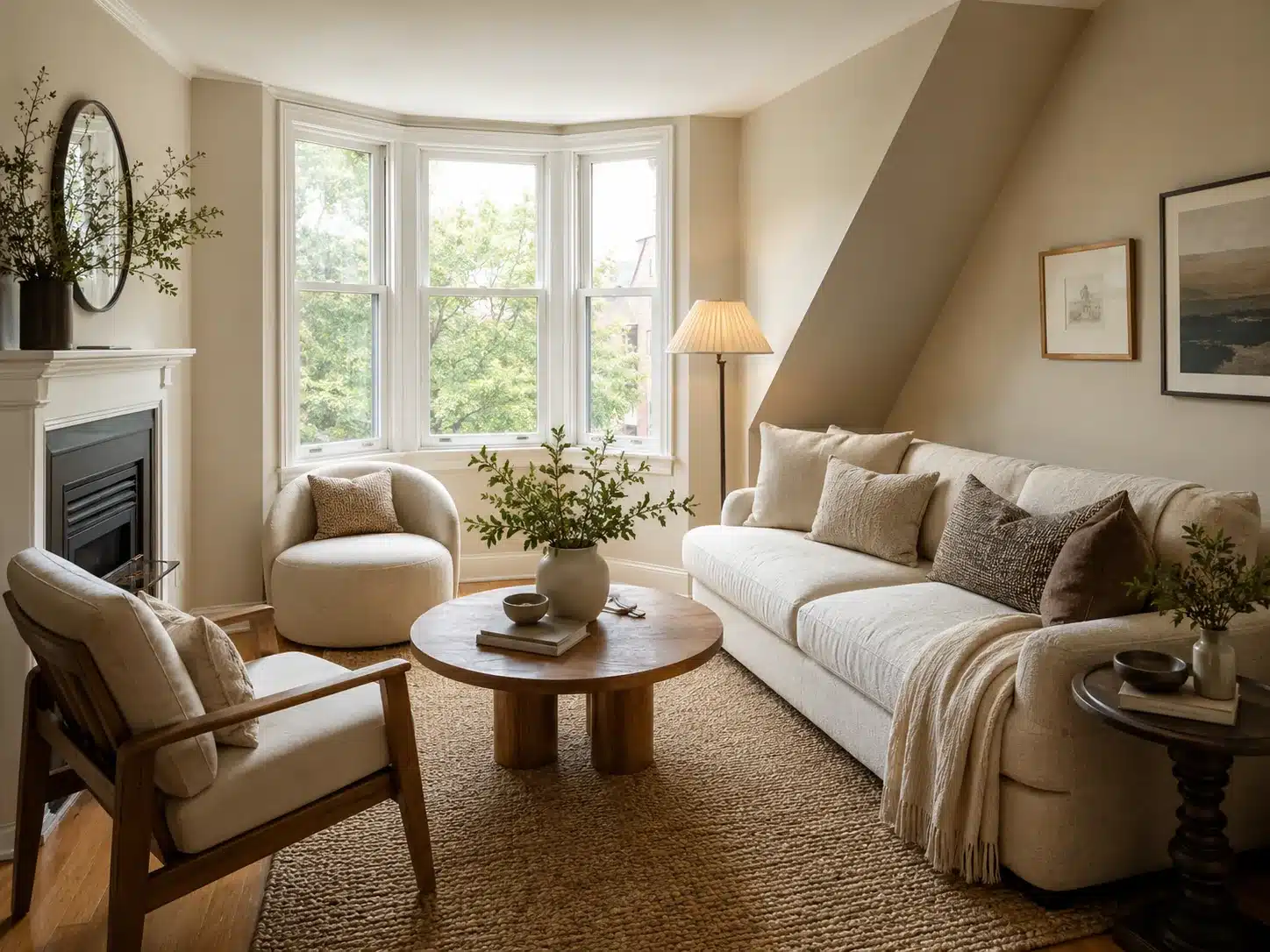
Not every living room comes in a neat rectangle. Odd angles, off-center windows, and awkward doorways are common in older homes and apartments — and they can make furniture arrangement feel like a puzzle with no solution. If you’re looking for small living room layout ideas for awkward spaces, these approaches work with your room’s quirks instead of fighting them.
1. Float Your Furniture Away from the Walls
It feels counterintuitive, but pushing every piece against the wall often makes an oddly-shaped room feel more awkward, not less. Pulling your sofa a few inches off the wall and angling it toward the room’s natural focal point (a window, fireplace, or TV) usually creates a more balanced layout than a rigid wall-hugging arrangement.
2. Use a Rug to Define the “Real” Shape of the Room
In a room with an odd angle or an alcove, a rug placed under your main seating area visually “resets” the space into a clean, defined zone — even if the walls around it aren’t symmetrical.
3. Anchor Awkward Corners with a Tall, Narrow Piece
A slim floor lamp, a tall plant, or a narrow bookshelf in an oddly-shaped corner turns a “dead zone” into an intentional design feature instead of empty, wasted space.
4. Let Furniture Follow the Traffic Path, Not the Walls
Instead of arranging around the room’s edges, map out how people actually walk through the space (from the door to the hallway, for example), and arrange seating around that natural path. This often solves layout problems that wall-based arrangements can’t.
5. Use a Round or Oval Coffee Table in Tight Spaces
Sharp rectangular corners are the main culprit behind bumped shins and cramped-feeling walkways in small or irregular rooms. A round or oval table softens the traffic flow and takes up less visual space.
6. Split an Oversized or Oddly-Shaped Room into Zones
If your living room is unusually large or L-shaped, don’t try to fill it with one big furniture grouping. Create two smaller zones instead — a main seating area and a secondary reading nook or plant corner — using a rug or furniture placement to separate them.
7. Mirror the Awkward Angle, Don’t Hide It
If your room has a strong architectural angle (a bay window, a diagonal wall), lean into it rather than trying to visually “square off” the space. A piece of furniture that follows the angle often looks far more intentional than one that fights it.
Awkward layouts usually aren’t solved by buying more furniture — they’re solved by rethinking how the furniture you already have relates to the room’s real shape.